The Overpacked Itinerary: Why Filling Every Hour Can Backfire
An overpacked itinerary can make travel feel like a chain of deadlines. Learn how to balance fixed commitments with realistic transitions and restorative pauses.
The most common itinerary mistake is treating every open hour as space that must be assigned; the cost is arriving at each place already thinking about the next one. An overpacked itinerary can leave too little time for the practical work of travel: finding a platform, eating properly, or sitting down when the day catches up with you.
A steadier pace is not simply a matter of leaving time blank. It means matching the day’s demands to your energy, the kinds of transitions involved and the amount of concentration each activity asks of you. A timetable can be full and still feel manageable, or sparse and surprisingly tiring.
Itinerary pace and effort
Itinerary pace describes how quickly activities and transitions follow one another. Count not only the stops, but also the effort between them: changing transport, orientating yourself, queueing, finding food and moving from one kind of experience to another.
Distance alone can mislead. A short route with an unfamiliar ticket machine and a crowded interchange may take more attention than a longer direct train journey. Likewise, a quiet museum visit and a steep walk place different demands on the body and mind, even if each occupies a similar part of the day.
Think of the day like a coat with seams: it is not just the panels, but how they join that determines whether it sits comfortably. In an itinerary, the joins are transfers, meals, rests and changes of setting. If those are squeezed, the activities can feel uncomfortable too.
Where the strain builds
Fixed commitments can make a day feel tighter than the calendar suggests. A timed museum entry, a train departure or a dinner booking may require you to watch the clock before and after the appointment. Add several such commitments and the spaces between them can become travel corridors rather than useful breathing room.
Repeatedly changing attention also has a cost. Moving from a crowded market to a formal gallery, then to a long walk and a social meal asks you to adjust to new surroundings and expectations. Some travellers enjoy that variety; others feel better when similar activities sit together or when a quiet interval follows a demanding one.
Ordinary needs belong in the plan, not outside it. Food, water, toilets and a place to sit may take attention to locate in an unfamiliar area. If a schedule treats every pause as a failure to sightsee, it can push you towards rushing or skipping what helps you feel well.
Match plans to energy
Start with the activities that have a genuine time constraint, then consider the effort they involve. A booking across town may require more than the journey itself: you may need to find the entrance, allow for a ticket check and recover from the transfer before enjoying the visit. Put those transitions on the page rather than assuming they will happen invisibly.
Next, look for demanding sequences. Several high-attention activities in succession can feel heavy even when they are close together. Consider placing a quieter activity, an unhurried meal or a simple return journey between them. The aim is not to make every day uniform, but to avoid treating energy as unlimited.
- Check fixed times: If an entry, departure or reservation has a narrow window, keep it as an anchor; if it can be changed or skipped, decide whether it is worth organising the day around.
- Check transfer complexity: If a route involves unfamiliar changes or several modes of transport, allow a calmer period around it; if it is direct and familiar, consider whether the transition needs less attention.
- Check activity demands: If a plan involves sustained walking, crowds or close attention, pair it with a gentler interval; if it is restful, it may sit more comfortably beside another visit.
- Check meal arrangements: If a booking fixes where you must be, include the journey and arrival in the plan; if not, leave the meal location undecided until you know where the day has taken you.
- Check access needs: If stairs, distance or facilities could affect someone in your party, confirm practical details with the venue or a qualified professional where appropriate; if the route does not suit, choose an accessible alternative.
- Check the return journey: If getting back depends on a limited service or a difficult connection, protect time to reach it; if there are straightforward alternatives, decide whether a more relaxed departure is workable.
Questions about daily pace?
How many activities suit one day?
There is no useful count that fits every destination and traveller. Begin with fixed commitments and their transitions, then judge whether the remaining activities suit the time and energy available.
How can I tell if a day is too full?
Look for a plan that leaves no room for food, toilets, delays or a change of energy. If one late departure would make you miss the next essential booking, consider removing or moving a commitment.
Should I book every popular attraction?
Book when access rules, a timed entry or your own priorities make advance arrangements useful. Check the attraction’s current instructions, and avoid adding a distant visit solely because it can be booked.
What should I do if my group has different energy levels?
Agree on the commitments everyone needs to share, then discuss which activities can be optional or done separately. If one person needs a rest or a different route, adjust the plan rather than expecting everyone to keep the same pace.
A worked day plan
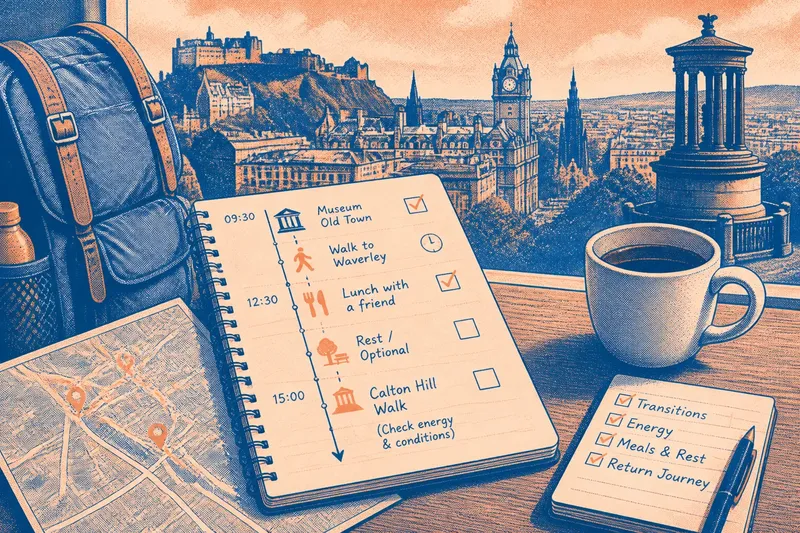
Say you are planning a day in Edinburgh, and these are invented details for illustration: a morning museum booking in the Old Town, lunch with a friend near Waverley station, and an afternoon walk up Calton Hill. You expect the museum visit to be absorbing, the lunch time to be fixed by your friend, and the walk to require more energy than sitting indoors.
First, you place the museum booking and lunch in the plan, along with the walk between the museum and station. Next, you leave a generous transition before lunch rather than adding another attraction nearby. You then check the route and current access information for Calton Hill; if the group still has energy after lunch, you go for the walk, and if not, you choose a nearby level stroll instead.
The resulting decision is clear: the museum and lunch are the day’s commitments, while the hill walk depends on energy and conditions. The trade-off is one fewer guaranteed sightseeing stop in exchange for a day less likely to become a race between appointments.
When a packed day fits
A tightly organised day can suit a short visit with a clear purpose, or a traveller who enjoys moving between planned activities. The important trade-off is plain: a firm sequence gives you certainty about what comes next, but leaves less room to linger, rest or respond to a delay.
A more measured itinerary suits activities whose duration is hard to predict, such as browsing a market, walking with friends or spending time in a gallery. If your plans depend on conversation or close attention, leave enough space for one activity to take longer than expected.
Before adding an appointment, ask whether it introduces a transfer, a new booking constraint or another demanding activity. If it does, decide what you are willing to shorten or remove; if nothing can move, the new stop may not fit the day comfortably.
Keep the day workable
An overpacked itinerary is not defined by a particular number of stops; it is a plan whose timing and effort leave little margin for ordinary needs. Use itinerary pace as a way to compare the demands of a day, not as a target to optimise.
Before leaving, check the fixed times, the transitions between them and the points where the day asks for sustained effort. If you can see where to eat, sit and adapt when a route takes more attention than expected, your itinerary is more likely to feel workable from morning to evening.